


Once the salt goes down on the roads and the temperature stays below ten degrees, most riders put the bike away. What you do in that last hour before you park it decides what you find in March: a machine that fires up straight away, or a flat battery, a rusty chain and staining on the aluminium.
Here is the full step-by-step guide, with what you need at each stage.
Short answer: winterise your motorcycle in 8 steps
- Wash the bike thoroughly and dry it completely.
- Clean, degrease and re-lube the chain.
- Fill the tank and take one last warm-up ride.
- Bring the oil change forward if the interval falls in spring anyway.
- Put the battery on a smart charger.
- Raise the tyre pressure or put the bike on stands.
- Use a cover that suits indoor or outdoor storage, never a plastic sheet.
- Take the plate off the road if you are not riding until spring.
When do you put the bike away?
In the Netherlands the turning point usually falls between mid October and mid November. It is not the calendar that decides, it is the road salt. As soon as the gritters go out, every piece of untreated metal on your bike is under attack, and that brine stays on the road surface for weeks.
Try not to park the bike up straight after a wet ride. Plan the last ride on a dry day so you can work on a warm, dry machine.
Step 1. Wash it and dry it completely
This is the step people skip most often and the one that costs the most. Dirt, insect residue and salt trap moisture against the metal. Over a full winter that means corrosion on fork legs, brake discs, bolt heads and bare aluminium.
Use a cleaner made for motorcycles and keep a pressure washer away from bearings, wheel hubs, chain links and electrical connectors. Rinse well, then dry the bike properly: with a cloth, with compressed air in the gaps, or by riding it for another half hour after washing.

More cleaning and care products are in the washing and polishing collection.
Step 2. Clean and lubricate the chain
A chain that goes into winter dirty often comes out with rust spots. Old chain lube holds sand and salt right against the O-rings.
Order of work: degrease, brush, let it dry, and only then lubricate. Chain spray on a dirty chain seals the grit in. Most bikes run an O-ring or X-ring chain, so use a lubricant made for that.


Everything is together in the chain care collection.
Step 3. Fuel and oil
Store the bike with a full tank. The less air there is in the tank, the less condensation can form against the wall. On a steel tank that is the difference between a clean interior and rust.
Petrol containing ethanol ages during long standstills and attracts moisture. If you are standing still for more than three or four months, many riders add a fuel stabiliser. Add it before your final warm-up ride so it reaches the whole fuel system.
On carburettor models it is common practice to drain the float bowls. With fuel injection that is not necessary.
Is your oil change due in spring? Do it now. Old oil contains acids and combustion residue that would otherwise sit in the engine all winter.
Step 4. The battery, where it usually goes wrong
Of all winter damage, a dead battery is by far the most common. Every battery slowly self-discharges, and an alarm, immobiliser and onboard computer draw current on top of that. A lead-acid battery left flat for months is permanently damaged.
The fix is simple: a smart charger that decides for itself when to top up. Connect it and leave it. No socket in the shed? Take the battery out and charge it indoors. One more reason to keep it charged: a full lead-acid battery handles frost far better than a flat one.
| Situation | What matters | Our pick |
|---|---|---|
| One bike, standard lead-acid battery | Maintenance charging you can forget about | OptiMATE 3 |
| Larger battery or a bike with a lot of electronics | More charging current and a fuller programme | OptiMATE 4 |
| Lithium battery (LiFePO4) | A charger with a lithium programme | OptiMATE Lithium |
| Just keeping it topped up, small budget | Basic unit for long standstills | OptiMATE 1 |
Always check on the product page which battery type the charger supports. A lithium battery does not belong on a charger without a lithium setting.

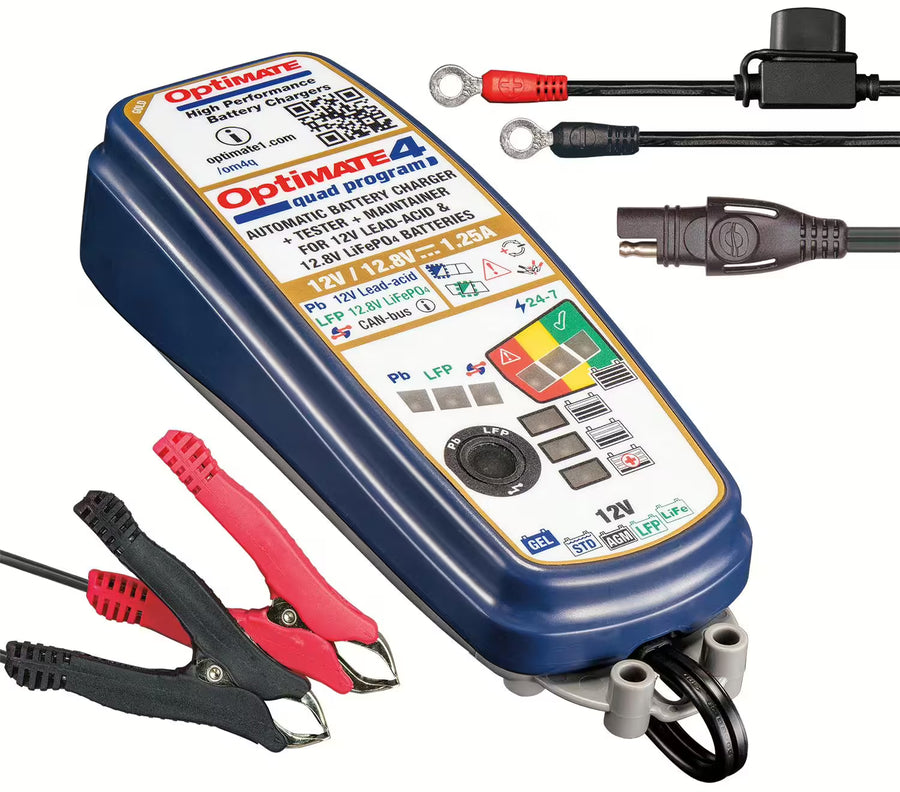


The full range is in the battery chargers collection.
Step 5. Tyres, suspension and weight
A tyre that sits under load on exactly the same spot for months can develop a flat spot. The risk is highest with low pressure and cold storage.
Two ways around it. The simple one: inflate to the maximum pressure marked on the sidewall and roll the bike half a turn once a month. The better one: put the bike on stands so the tyres carry no weight at all and the suspension is unloaded.


No centre stand and you want the bike parked upright without any fuss? A front wheel chock is a practical answer. You ride straight into it and the bike stands up on its own.

More options are in the paddock stands collection.
Step 6. The right cover: indoors is not the same as outdoors
This is where it often goes wrong. An airtight cover or a plastic sheet traps moisture: it warms up during the day, cools down at night, and the condensation settles on the bike. Under a cover like that a bike rusts faster than with no cover at all.
What you want is a cover that keeps water out but lets vapour through, with vents and a soft lining that will not mark the paint.
| Where the bike is stored | What you need | Our pick |
|---|---|---|
| Dry shed or garage | Breathable dust cover with a soft lining | Oxford Dormex |
| Outdoors or under a carport | Waterproof and breathable, with vents | Oxford Rainex |
| Outdoors all winter, plenty of wind | Heavier cover, reinforced and easy to secure | Oxford Stormex |
| No shed, but a driveway | A full folding garage instead of a cover | Oxford Protex folding garage |


Only fit the cover once the bike is completely dry and cooled down, and secure it properly against wind. All sizes are in the motorcycle covers collection.
Step 7. Protect paint and metal
A layer of wax or a ceramic coating on paint, chrome and polished aluminium gives the bike a water-repellent surface through the winter. Moisture and dust stick less easily, and in spring the dirt washes off in one go.
Do not forget the areas you normally skip: the underside of the frame, the inside of the fork legs and the swingarm take the most salt.
Step 8. Taking the plate off the road
If you are not riding between November and April, you can suspend your registration. For Dutch-registered motorcycles this is arranged through the RDW.
What suspension means:
- You pay no road tax for the suspended period.
- Third-party insurance and a valid roadworthiness test are not required.
- The bike may not be ridden or parked on public roads, so you need your own storage space.
- You arrange it online with the RDW or at a counter, for 1, 2 or 3 years. It takes effect immediately.
- Road tax stops automatically, but you have to pause or cancel the insurance yourself.
Two things to keep in mind. If you lift the suspension within a month, you still pay road tax for that period. And without insurance your bike is not covered against theft or fire in storage either, which is why many riders keep limited cover running. Current rates and conditions are on rdw.nl. Other countries have their own arrangements, such as the seasonal plate in Germany.
What not to do
- Starting the bike every couple of weeks. A few minutes at idle does not bring the engine and exhaust up to temperature. The water produced during combustion condenses and stays behind in the oil and the silencer. Leave it parked, or go for a proper half-hour ride.
- Putting a cover over a wet bike. That moisture has nowhere to go.
- Disconnecting the battery and leaving it in a cupboard. Without a charger it goes flat there just the same.
- Chain spray on a dirty chain. You are lubricating the grit in rather than out.
- Parking on bare concrete. Concrete draws up moisture. A mat or a couple of boards under the tyres already makes a difference.
Getting it back out in spring
Run through these before the first ride: tyre pressure and tread, brake fluid and brake performance, chain tension and lubrication, coolant and oil level, lights and battery voltage. Take the first few kilometres gently, because both tyres and brakes need a moment before they grip properly again.
Check your gear too. Just before the season is exactly when you find out your gloves are no longer waterproof. Our guide on staying warm on your motorcycle covers how to get through the colder months if you keep riding.
Frequently asked questions about winter storage
Do I need to take the battery out?
Only if there is no socket where you store the bike. If there is power, leaving the battery on a smart charger is easier and better. If you do remove it, still connect it to a charger indoors rather than leaving it in a cupboard.
Full tank or empty tank?
Full. A full tank leaves little room for air and therefore for condensation. Only on carburettor models is the float bowl usually drained, and even then the tank itself stays full.
Should I start the bike now and then over winter?
No. Brief idling never brings the engine up to operating temperature and leaves moisture and unburnt fuel in the oil. That does more harm than standing still. If you do want to ride, make it at least half an hour on a dry, salt-free day.
Can my bike stay outside over winter?
It can, provided it is well protected. Use a waterproof and breathable cover with vents, secure it firmly against wind, and make sure the bike is not standing directly on damp ground. A folding garage is a step up from a cover if you have no shed.
Do I need a cover indoors as well?
Yes, but a different type. Indoors it is about dust and scratches, not rain. A breathable dust cover with a soft lining is the right choice there. Using a waterproof outdoor cover indoors traps moisture.
How long can a bike stand without problems?
With a charger on the battery, a full tank and a clean, lubricated chain, a motorcycle will sit through a winter without trouble. Without those three, the first consequences show after about three months: a battery that no longer holds up, and surface rust on the chain and brake discs.
In short
Winterising takes one Saturday afternoon and saves you an expensive surprise in spring. The three steps that make the biggest difference are the battery on a charger, a clean and lubricated chain, and the right cover for wherever the bike is stored.
Not sure which charger suits your battery, or which cover size fits your model? Get in touch and we will work it out with you before you order.